Sappho: the poet and her work
The Greek poet Sappho lived on the island of Lesbos from c.630BC to 570BC. She came from an aristocratic family and had independent means. She was a poet, and a teacher of songs and singing. She was the leader of a group of unmarried young women. Beauty and fashion were important to her: women had to look the part.
Her writing includes erotic material disclosing lesbian love. She also had a feminist take on Greek mythology. It seems she was just more interested in women than men. She was the first writer to express female desire as important in itself.
Sappho wrote nine books of poetry, although most of it is gone – fewer than 400 lines survive today. I have been reading her work in Stung with Love: Poems and Fragments of Sappho (Penguin, 2009). I find it lyrical and beautiful. Here are the extracts that moved me most.
But a strange longing to pass on
Seizes me, and I need to see
Lotuses on the dewy banks of Acheron.
(p.21)
This is an expression of death-longing which was apparently typical of the sapphic experience of Eros. In Greek mythology, Acheron is the underworld lake across which Charon ferries the ghosts of the dead. Lotuses grow on its shore and are associated with forgetfulness. Farewell, cruel mistress…
‘You culled violets and roses, bloom and stem,
Often in spring and I looked on as you
Wove a bouquet into a diadem.’
(p.25)
The poet remembers the good times, when saying goodbye to her sorrowful female lover at the end of their relationship.
As for you girls, the gorgeous ones,
There will be no change in my plans.
(p.25)
These girls are the beautiful young women with whom the poet surrounded herself. I can only speculate on what she had in mind in this isolated fragment.
Your need to sing
Flutters about you in the air -
You gorgeous thing.
(p.25)
The poet is addressing her musically-talented lover (who, we learn elsewhere, played the lyre). But desire quickly overcomes her. The fragment as a whole shows how beauty and love interact with each other in the sapphic world.
The significance of violets
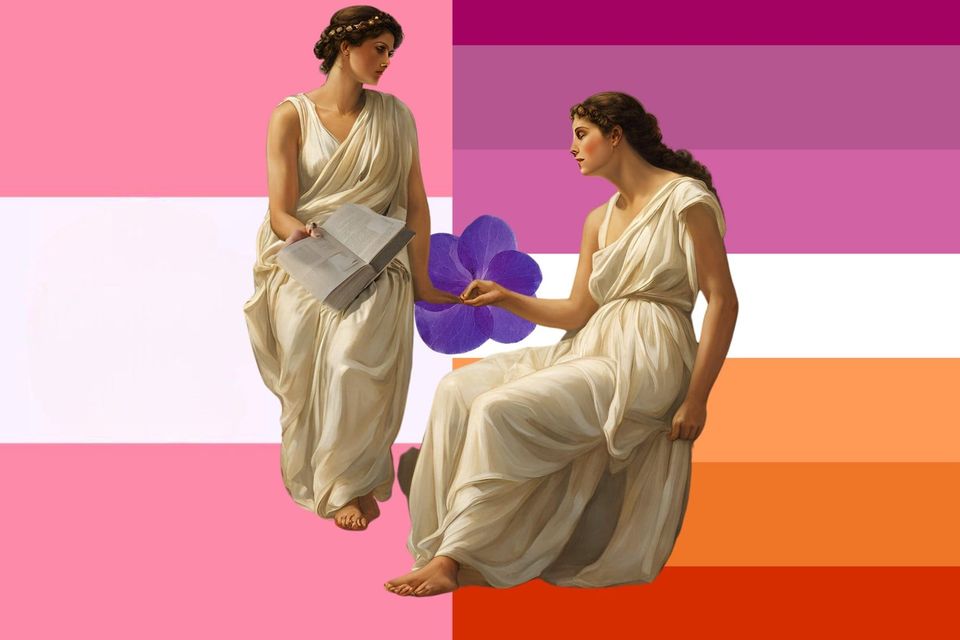
Floral imagery runs throughout Sappho’s poetry. Especially violets. These were the flowers that she loved to wear herself. As a result, the violet has been linked to lesbian love ever since that time.
This point is a made in a famous theatrical example. The 1926 play The Captive, staged in Paris and New York, recounted the story of the forbidden love between two women, one of whom sends several bouquets of violets to her lover. The play was controversial for its time. It prompted many women to pin violets to their jackets in solidarity.
Sapphic or lesbian?
These terms are grounded in the same historical moment: Sapphic takes its name from Sappho the poet, and lesbian from the island of Lesbos where she lived. Lesbian is the much better-known term.
Visually, the difference between sapphic and lesbian is clear in their respective flags. The sapphic flag has a narrower colour range and carries an image of a violet.
Semantically, though, it’s harder to work out. The terms occupy the same playing field but they do not mean the same thing.
Sapphic is the wider term, conveying attraction to women of all identities (straight women, trans women, bisexual women, pansexual women etc), and also to people who are non-binary, or who fall into any category as long as it is a non-male category.
Lesbian is a narrower term, referring specifically to attraction between two women. So all lesbians are sapphic, but not all sapphics are lesbian.
I don’t find this entirely clear. I strongly believe that trans women are women. Does that mean that the love of a woman for a trans woman is lesbian love or sapphic love? There may be an answer out there, but I haven’t found it yet. There is definitional ambiguity. And so I am not sure how I would describe myself.