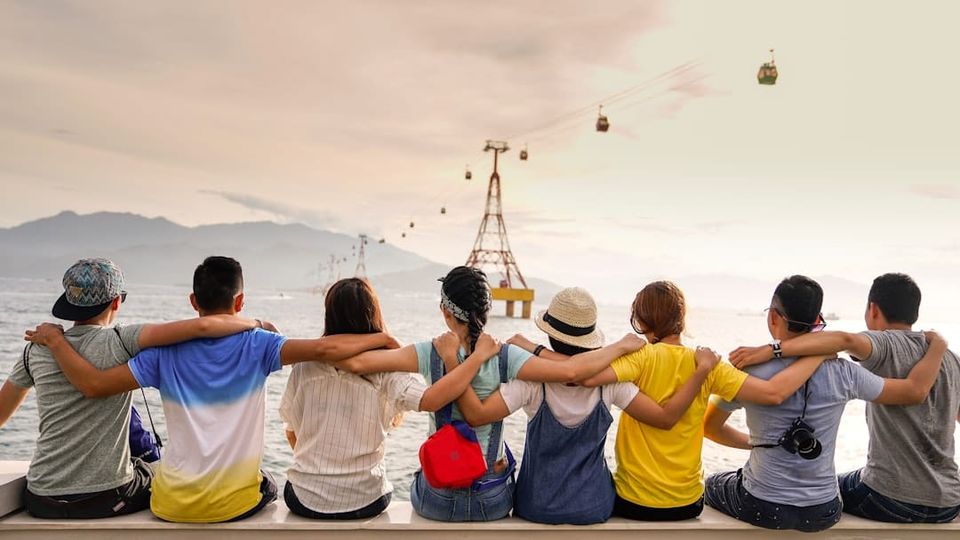
‘I have given them the glory that you gave me, that they may be one as we are one – I in them and you in me – so that they may be brought to complete unity. Then the world will know that you sent me and have loved them even as you have loved me’ – John 17.22–23.
The Bible could not make it clearer. Christians are meant to be united. We should live in harmony with each other. This shows the world the saving love of God which is bestowed on the people of God. And yet – look at what we have done to each other…
The early years
Let’s start with an example from a different context: the factionalism of left-wing politics. In 1st century Palestine, discontent with the Roman occupation manifested itself in the formation of a number of groups who shared the same overall aim of reclaiming their country. These were:
- The Campaign for a Free Galilee
- The Judean People’s Front
- The Judean People’s Popular Front
- The People’s Front of Judea
- The Popular Front of Judea.
You might ask why there are so many groups as this could only serve to dissipate the energy of the movement. You might also expect them to work together for the common good. But the surviving records from this time reveal bitter infighting and a deep distrust of others whom they regarded as heretical. In the language of sociology, this is known as the narcissicism of small differences.
Returning to the Church, the body of Christ may have been united in the very earliest days but it was not long before divisions were appearing. The apostle Paul was much exercised by what he found in the church at Corinth:
I appeal to you, brothers and sisters, in the name of our Lord Jesus Christ, that all of you agree with one another in what you say and that there be no divisions among you, but that you be perfectly united in mind and thought – 1 Corinthians 1.10.
The point is that if Christians argue with each other, even to the extent of taking legal action, it tells the world that we are no better than the rest of them. These Christians are not so different after all…
In the following centuries, unity gave way to division as the Church tried to define what it believed about what God had done and why. Some of the differences were fundamental (for example whether Jesus was fully divine). Others seem trivial now but were very important at the time (did the Holy Spirit proceed from the Father only, or from the Father and the Son?) The Church divided into Eastern and Western branches. Relations between the two deteriorated to such an extent that the leaders of the Eastern and Western branches excommunicated each other in the year 1054. The excommunications were not lifted until 1965.
Western Christianity subdivided further in the 16th century. The Reformation split the Church into Catholic and Protestant. Superficially, the Catholic side remained monolithic, supported by a very strong central authority, while the Protestant side continued to divide – Anglican, Lutheran, Reformed, Dissenting, Non-Conformist, Millenarian and so on.
A case study in division Part 1: Scotland
I know of no better example of the tendency of the Church to subdivide than in Scotland. The official or state church is the Church of Scotland, established in 1560. This is a Presbyterian church in the Reformed tradition. A number of evangelicals broke from the Church of Scotland in 1843 in protest at what they saw as state encroachment on the spiritual independence of the Church. They formed the Free Church of Scotland. Most of them split off in 1900, joining the United Presbyterian Church of Scotland (another 19th century creation) to form the United Free of Church of Scotland, and most of this later group reunited with the Church of Scotland in 1929. A minority remained in the Free Church of Scotland.
Although both the Church of Scotland and the Free Church of Scotland share the same theological understanding and system of church governance, they remain separate bodies and they hold different views on many issues. Take same-sex marriage for example. Following a vote at the 2022 General Assembly, Church of Scotland ministers and deacons who choose to do so may marry same-sex couples. In contrast, the Free Church of Scotland is opposed to same-sex marriage and also supports the use of conversion therapy for LGBT Christians.
I should also mention the Free Presbyterian Church of Scotland, which split from the Church of Scotland in 1893 because they regarded the official church as insufficiently rigorous (in not adhering to the Westminster Confession as a credal statement). Although the Free Presbyterian Church of Scotland and the Free Church of Scotland are very similar (both adhere to the Westminster Confession), they remain separate organisations. The Free Presbyterian Church considers it a sin to use public transport to attend divine worship on Sundays: the Free Church does not. The Free Presbyterian Church only uses the Authorised Version of Bible whereas the Free Church allows the use of modern translations.
You could be excused for wondering whether part of the body of Christ in Scotland has driven down a cul-de-sac where purity of belief takes precedence over unity. Look no further than the way the Free Presbyterian Church of Scotland treated its most famous member, later an ex-member, Lord Mackay of Clashfern. This strict sabbatarian, honorary president of the Scottish Bible Society, and Lord Chancellor for 10 years until 1997, was a noble and compassionate man – as I know from meeting him on a number of occasions. His church forbids attendance at Catholic services as it regards this as supporting Catholicism. Nevertheless, Lord Mackay attended two Catholic funeral masses of judicial colleagues in the 1980s. For this, his church expelled him from membership. The story made the national news. If the church was concerned to promote Christianity to the world then this was an own goal of epic proportions.
A case study in division Part 2: Rome
But the Catholic Church is not free from division either. The Catholic Church went through a process of significant modernisation in the 1960s under the leadership of Pope John XXIII who convened the Second Vatican Council. Among other things the Council opened the way to the development of ecumenical relations with other Christian churches and provided for the mass to be said in the vernacular as an alternative to Latin. Vatican II was massive for the Catholic Church, but a vocal minority of traditionalists opposed its decisions.
In 1970, to ensure that the old ways would continue, Archbishop Marcel Lefebvre founded the Society of Saint Pius X (named after this anti-Modernist pope who died in 1914). The Society has over 1,000 members including over 700 priests. Although tolerated by Rome, the Society maintains a separate structure of parishes where the traditional rite is observed and the Latin Mass is said exclusively. My discussions with one member of the Society show that it regards itself as the authentic Church of Christ in the Roman tradition, in contrast to the vast majority of Catholics who have been led astray by false leadership and liberal teaching. If there was a recognised term for this condition, it might be Walled Garden Syndrome.
The operation of a structure within a structure can manifest itself in absurd ways. Take for example the issue of devotion to the Blessed Virgin Mary – something on which both the official Catholic Church and the Society of St Pius X should be able to agree. The official Catholic Church contains an organisation known as the Militia of the Immaculata. This describes itself as ‘a worldwide evangelization movement founded by St Maximilian Kolbe in 1917 that encourages total consecration to the Blessed Virgin Mary as a means of personal conversion and sanctification, and of spiritual renewal of society.’ Head over to the Society of St Pius X and you find an organisation known as the Militia Immaculatae, or Knights of the Immaculata. This describes itself as ‘a worldwide Marian movement for the sanctification of Catholics and the conversion of non-Catholics, under the patronage of the Blessed Virgin Mary. It was founded by St Maximilian Kolbe in 1917 as a movement to raise and include all Marian movements in response to the terrible forces arrayed against the Church in our times.’
These look like the same organisation with the same founder and the same purpose. But in fact they are completely different. The official Militia of the Immaculata has issued this disclaimer: ‘Please be advised that the Society of St Pius X (SSPX), a Catholic group not in full communion with the Roman Catholic Church, promotes the MI under the name “Militia Immaculatae of Traditional Observance,” but has no historical and canonical connection with the MI Movement founded by St. Maximilian Kolbe in 1917, nor authorization to do so.’ There is no equivalent denunciation by the SSPX who simply ignore the existence of the official body.
It is a mercy for the Roman Catholic Church that its internal divisions do not attract much publicity. Or at least I used to think. Recently the SSPX ordained four new bishops at its HQ in Switzerland despite the Pope specifically asking them not to. This kind of behaviour is traditionally an excommunication offence. The Pope went further than that, excommunicating not only the new bishops (and whoever consecrated them), but the entire SSPX organisation and all its adherents. I know from discussions with an active member that the SSPX is in defiant mode and intends to Keep Calm and Carry On.
The Ecumenical movement
I find oppressive all this argument and division within the Church. I have been working for greater unity among the different branches of the Church for a long time – principally through involvement in the ecumenical movement in its various local Churches Together manifestations. I still remember a local Churches Together meeting about 30 years ago whose main issue was whether to admit the Religious Society of Friends (the Quakers) to membership. Quakerism is clearly rooted in Christianity, stressing the guidance of the Holy Spirit but rejecting ordination, liturgy, and any credal statement of belief. One of the local evangelical churches objected to the admission of the Quakers because they did not subscribe to the doctrines of the Church as set out in the creeds or other recognised statement of faith. I made the point in debate that what united us as Christians was both fundamental and also much more important than what divided us, and that we were clearly called to unity on the authority of scripture. This may have had some effect on the meeting because it then voted to include the Quakers in its membership.
Such a contrast between the human tendency to division and the divine call to harmony. Let's finish on an upbeat note, so here is the apostle Paul (again) in the Letter to the Ephesians:
As a prisoner for the Lord, then, I urge you to live a life worthy of the calling you have received. Be completely humble and gentle; be patient, bearing with one another in love. Make every effort to keep the unity of the Spirit through the bond of peace. There is one body and one Spirit, just as you were called to one hope when you were called; one Lord, one faith, one baptism; 6 one God and Father of all, who is over all and through all and in all – Ephesians 4.1–5.