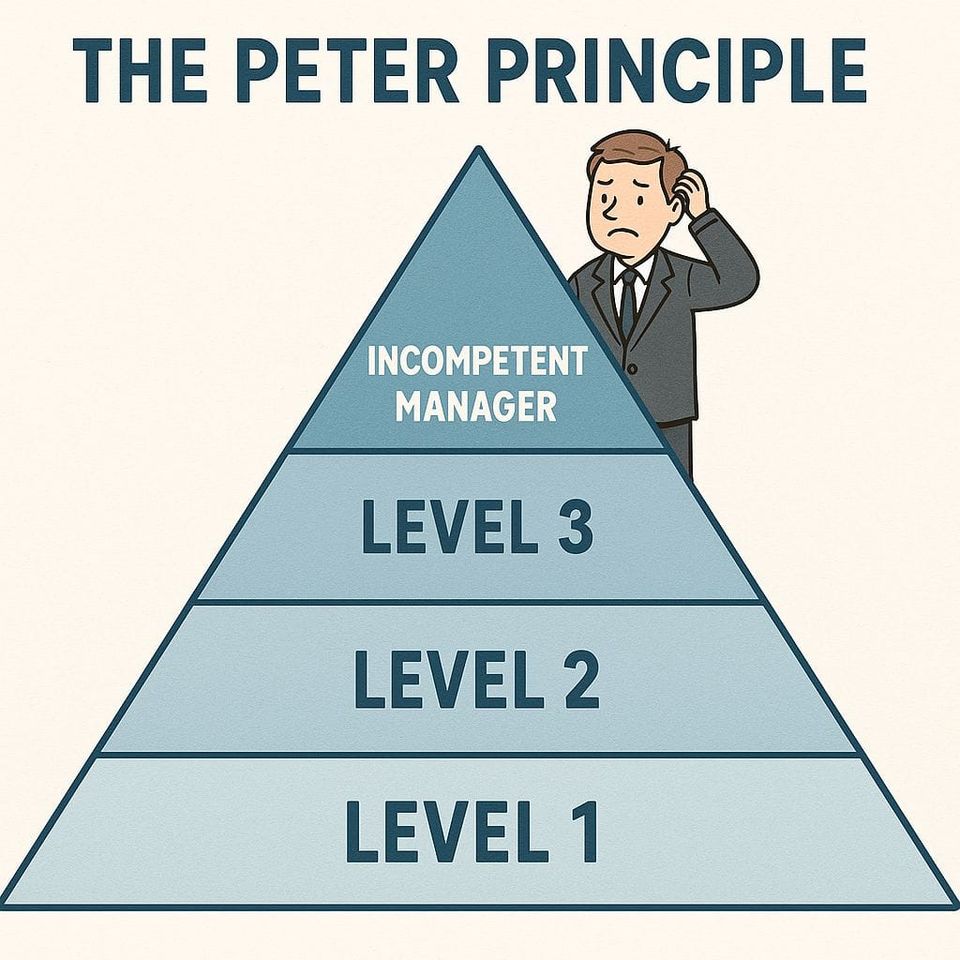
This is a concept in management theory. Employees do a good job and are promoted to another job at the next level up. This may require different skills. They may succeed or not, but at some point, they will be promoted beyond the level where they can perform effectively. So we see the classic expression of the Peter Principle: 'In a hierarchy, every employee tends to rise to his level of incompetence.'
It's called the Peter Principle because it was developed by the Canadian educator Laurence J. Peter and published in the 1969 book The Peter Principle. Believe it or not, he originally intended this as satire. But he was actually making a serious point.
Every now and again, some public figure rises to prominence and then falters. You have to ask yourself, Is the Peter Principle at work here?
Enter, stage left: the current British Prime Minister, Andy Burnham. Most recently the Mayor of Greater Manchester. He was popular and effective in this role. Notably for overseeing the creation of a cheap and efficient bus and tram public transport system in Manchester. In the process he became the darling of the centre-left. As Starmerism descended into futility quicker than anyone thought possible, Burnham rose to prominence as the only Labour politician who was thought capable of stopping Nigel Farage leading Reform to a general election victory next time round. So he replaced Starmer as the frontman in what can only be described as a coronation.
Burnham seemed to make a good start. He is a much better public speaker than Starmer. He talked a lot about making life better for the public at large: focusing on the cost of living crisis. Labour is now topping the public opinion polls again, slightly ahead of Reform in second and – improbably – the Conservatives in third. This is what one would expect in a honeymoon period.
The problem for Burnham is that the problems facing the UK as a whole are larger, more difficult, and different in kind from those facing the residents of Greater Manchester. Different skills are required. I am not the only person asking whether Burnham is actually up to the job. Has he risen above his comfort level?
Because, despite the talk, Burnham has done nothing that will address the substantial problems this country faces. Nowhere is this more evident than in what we what we now call the climate crisis – for global warming has gone beyond a scientific alert and is now impacting the lives of very many people in a very bad way. The UK is simply too hot, like the rest of Europe in particular, and has been too hot for too long. The country is burning.
Objectively, the government should take radical action to address the climate problem. We must reduce the carbon emissions that cover the planet like a blanket. So this means developing renewable clean energy as quickly as possible. And holding firm to the internationally-agreed targets.
What has the Prime Minister done? The direction of travel seems to favour fossil fuel energy. More drilling for oil in the North Sea. And relaxing the targets for the manufacture of electric vehicles. And the crowning glory of his climate strategy: asking supermarkets if they would be good enough to stop selling disposable barbecues.
The radical left has made fun of the Prime Minister's initiative: Polanski, for the Greens, and Zarah Sultana, for Your Party, in particular. It was easy for them to do that. They're not in government and don't realise how difficult government can be. On the other hand, when your situation is desperate, you have to act boldly. Dealing with the climate crisis is likely to be expensive, certainly in the short term even though renewable energy is the cheaper long term option. That means facing down the vested interests, and raising serious amounts of money from those sections of society which are best-resourced to provide it: the very rich, and the powerful.
In this area in particular, as in others, the Manchesterism that Burnham popularised is just not going to cut it. The Peter Principle strikes again.